
ELEGOO UNO R3 Project Super Starter Kit
4.7Editor score
Includes 22+ guided lessons
Complete component variety
Solderless setup for beginners
This guide compares the top Arduino Uno Q boards and kits for 2026, covering hybrid processing, AI capabilities, and connectivity options for makers and
The Arduino Uno Q represents a significant leap in microcontroller technology by merging traditional real-time control with powerful Linux-based computing capabilities. This hybrid approach allows developers to run complex AI models alongside deterministic control loops without needing separate hardware. It opens new doors for robotics and IoT projects that require both immediate sensor responses and sophisticated data processing at the edge.
We evaluated ten top products including official boards and comprehensive starter kits to help you find the right solution for your specific needs. Our analysis focused on processing power, memory capacity, connectivity options, and the ecosystem support available for each configuration. We also considered the value proposition of kits that include essential accessories like power supplies and cases to streamline your development workflow.
Each pick in this list showcases unique strengths ranging from barebone boards for custom integrations to fully equipped kits for immediate project launch. Please note that availability and pricing can fluctuate frequently so always verify the current details before making your final purchase decision. We hope this guide helps you select the perfect platform to bring your innovative ideas to life efficiently and effectively.
4.7Editor score

4.4Editor score
3.7Editor score
This side-by-side comparison highlights the key specifications and unique features of the top ten Arduino Uno Q related products available today.


The Arduino® UNO™ Q 4GB stands out as a revolutionary hybrid board that bridges the gap between simple microcontrollers and full single-board computers. With a rating of 4.4 stars it combines the Qualcomm Dragonwing QRB2210 MPU and STM32U585 MCU to deliver both high-level processing and precise real-time control. This makes it ideal for projects requiring AI vision or voice recognition alongside standard robotics tasks.
We may earn a commission when you buy through this link, at no additional cost to you.
Its standout quality lies in the ability to run Linux Debian OS while maintaining the familiar Arduino ecosystem. You can write Python scripts for complex tasks and Arduino Sketches for hardware control within the same interface. The inclusion of 4GB RAM and 32GB eMMC storage ensures you have enough resources for multiple processes and extensive logs without external storage.
Honest trade-offs include the steeper learning curve required to manage a dual operating system environment. It is significantly more expensive than standard Uno boards which might be overkill for simple LED blinking projects. However for advanced IoT and robotics applications these trade-offs are acceptable given the massive performance leap.
You should buy this if you are an experienced developer looking to prototype sophisticated AI and robotics systems. It empowers innovators to mix Python scripts containerized models and sketches seamlessly. For those ready to move beyond basic microcontroller limitations this board offers the perfect unified development experience.
The onboard AI acceleration allows for object recognition and motion detection without cloud dependency ensuring privacy and lower latency.
Dual-band Wi-Fi and Bluetooth 5.1 enable robust wireless communication while the Qwiic connector simplifies adding sensor nodes.
We may earn a commission when you buy through this link, at no additional cost to you.
This kit version of the Arduino UNO Q provides the same powerful hybrid hardware as the base board but adds a crucial 45W USB-C power supply. Designed for engineers building scalable AI systems it ensures that your board receives stable and regulated power during intensive computing tasks. The 4GB RAM capacity supports advanced multitasking and edge AI applications effectively.
We may earn a commission when you buy through this link, at no additional cost to you.
The key strength is the inclusion of a high-wattage power adapter which is often an overlooked requirement for high-performance computing. When running Linux and heavy models the board may demand more power than a standard USB port can provide. This kit solves that issue ensuring reliable operation even when connecting multiple peripherals or running sustained workloads.
One honest trade-off is that the specific rating is currently listed as N/A which makes it harder to gauge community feedback compared to other items. Additionally it costs more than the board alone so budget-conscious buyers might prefer buying power separately if they already have a high-wattage source.
Developers should buy this if they want a plug-and-play solution for industrial IoT and robotics systems. It eliminates the guesswork of power requirements and ensures your setup is robust from day one. The focus on advanced projects makes it a practical choice for professional environments.
The included 45W supply prevents voltage drops during peak performance ensuring consistent operation for critical applications.
Combines real-time control with AI acceleration for building scalable automation systems that require both precision and intelligence.
We may earn a commission when you buy through this link, at no additional cost to you.
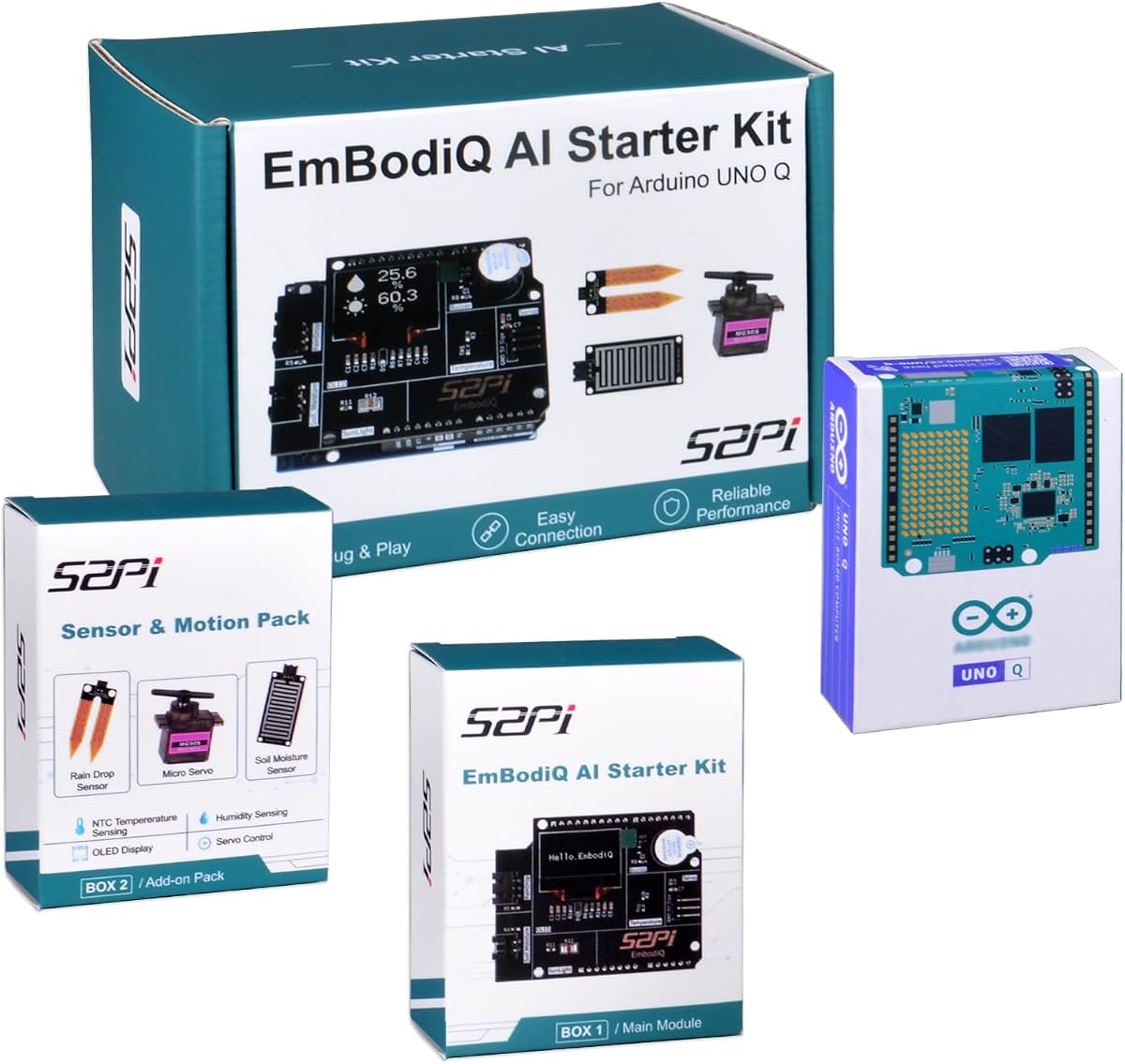
The GeeekPi EmbodiQ AI Starter Kit transforms the UNO Q into an intelligent assistant that understands natural language commands. With a rating of 3.7 it offers a unique approach where you can tell the AI what you want to do without writing complex code. This makes advanced robotics accessible to those who prefer logical commands over traditional programming.
We may earn a commission when you buy through this link, at no additional cost to you.
Its standout feature is the EmbodiQ AI Agent HAT which runs on the 4GB RAM board to enable real-time reasoning and multi-step task execution. It works with various OpenAI-compatible APIs allowing you to choose your preferred model easily. The kit includes soil moisture and raindrop sensors making it perfect for smart gardening or weather stations immediately.
Honest trade-offs include the lower rating which suggests some users may find the natural language interface less reliable than direct code control. The setup involves configuring web interfaces and terminal REPL which can be daunting for absolute beginners. However the flexibility to switch models is a significant advantage for power users.
You should buy this if you are an AI enthusiast or educator interested in demonstrating language-based hardware control. It simplifies complex logic for students and allows for rapid prototyping of voice-controlled devices. For those exploring the frontier of AI interaction with physical hardware this kit is a compelling option.
Interact with servos and sensors through simple text or voice inputs removing the barrier of complex syntax for beginners.
Includes specific sensors for environmental monitoring allowing for immediate deployment in smart home or agriculture projects.
We may earn a commission when you buy through this link, at no additional cost to you.
While not the Q model this ELEGOO UNO R3 Project Super Starter Kit is a top contender for anyone starting their Arduino journey. With a strong 4.7 rating it provides a comprehensive set of components and tutorials that turn code into real-world results efficiently. It includes everything from sensors to motors making it ideal for family builds or classroom units.
We may earn a commission when you buy through this link, at no additional cost to you.
The key strength lies in its structured approach with over 22 guided lessons that teach digital input output and motor control. The solderless design allows beginners to focus on wiring and logic without the frustration of soldering initially. It helps learners understand the logic before creating their own projects by changing thresholds and sequences.
An honest trade-off is that it uses the standard R3 controller rather than the advanced hybrid Q architecture. For projects requiring heavy AI processing this board lacks the power of the new Q models. However for learning the fundamentals of electronics this is often exactly what you need.
You should buy this if you are a beginner looking for a structured introduction to electronics and programming. It offers incredible value with a vast array of components and clear documentation. For those prioritizing learning basics over high-performance computing this kit is a proven winner.
Includes diverse components like ultrasonic sensors and servos ensuring you can build various projects without buying extra parts.
Detailed PDF tutorials guide first-time builders through setup and troubleshooting reducing the frustration of initial assembly.
We may earn a commission when you buy through this link, at no additional cost to you.
This kit is tailored specifically for the UNO Q and bundles the official board with essential accessories for a complete embedded development experience. Rated 4.6 stars it includes a protective aluminum case and a USB-C hub with Ethernet which significantly expands the board's connectivity. You can use the board as a standalone computer with a monitor and keyboard right out of the box.
We may earn a commission when you buy through this link, at no additional cost to you.
The key strength is the rugged housing that protects the board from dust and static while ensuring efficient heat dissipation. For professional applications the included Ethernet hub makes networking stable and reliable. It bridges the gap between a barebone board and a finished product ready for deployment.
One trade-off is that it includes the 2GB RAM version of the board which has less memory than the 4GB variants. For heavier AI models this might be a limitation compared to the higher-spec kits. However for standard embedded projects the storage and RAM are usually sufficient.
You should buy this if you need a durable ready-to-use solution for professional or educational embedded projects. The aluminum case and hub make it far easier to set up than buying accessories separately. It is a solid choice for those who value protection and connectivity.
Dual operating modes allow you to use the board as a full PC or connect via USB for traditional Arduino coding.
The USB-C hub with Ethernet port ensures professional-grade network connections essential for IoT deployments.
We may earn a commission when you buy through this link, at no additional cost to you.
The Arduino Uno REV3 is the quintessential board that defined the maker movement and remains a staple in classrooms worldwide. With a 4.8 rating it is powered by the reliable ATmega328P microcontroller offering a simple yet effective platform for learning. Its widespread use ensures you will find endless libraries examples and community projects to support your work.
We may earn a commission when you buy through this link, at no additional cost to you.
Its key strength is the simplicity and reliability for basic to advanced electronics projects. The 14 digital I/O pins and 6 analog inputs provide flexible options for sensors and motors without needing complex wiring. Full compatibility with the Arduino IDE ensures easy access to code examples and community-driven projects.
An honest trade-off is that it lacks modern connectivity like native Wi-Fi or Bluetooth which limits remote capabilities. It is also older than the Q models so it cannot run Linux or advanced AI. However for standalone devices this remains a robust and trusted choice.
You should buy this if you are a student or beginner focusing on learning the fundamentals of electronics. It is perfect for prototyping and robotics projects where internet connectivity is not required. For those needing a stable standard board this is the default choice.
The standard for teaching electronics programming it is perfect for STEM classrooms and self-paced learning.
Access a vast array of community-driven libraries ensuring you can add complex features without writing code from scratch.
We may earn a commission when you buy through this link, at no additional cost to you.
The Arduino UNO R4 WiFi brings modern connectivity to the classic form factor with built-in Wi-Fi and Bluetooth capabilities. Rated 4.7 stars it combines the Renesas RA4M1 and ESP32-S3 chips to offer robust dual-core processing for wireless control. The 12×8 LED matrix provides immediate visual feedback for status indicators or simple displays.
We may earn a commission when you buy through this link, at no additional cost to you.
Its key strength is the wireless connectivity which makes remote sensors and IoT projects seamless without extra modules. The modern USB-C port improves ease of use and the Qwiic connector simplifies adding I2C sensors. This makes it ideal for smart devices that need to communicate over a network.
One trade-off is that it does not have the full Linux capabilities of the Q models but it still offers powerful edge AI applications. It is less powerful in terms of pure computing but excellent for dedicated IoT tasks. The visual feedback is a nice touch but requires code management.
You should buy this if you are building IoT projects that require wireless communication and quick visual status updates. It is a great upgrade from the classic Uno for those needing Wi-Fi without a shield. For advanced embedded projects this board delivers modern features effectively.
Robust Wi-Fi and Bluetooth ensure stable operation for remote sensors and smart devices.
The built-in LED matrix allows for dynamic visuals and user interfaces directly on the board.
We may earn a commission when you buy through this link, at no additional cost to you.
The ELEGOO UNO R3 Board offers a practical and affordable alternative to the official board for everyday projects. With a 4.7 rating it features the ATmega328P core and comes with a USB cable ready for immediate coding. The ATmega16U2 interface ensures reliable sketch uploads and serial communication with your computer.
We may earn a commission when you buy through this link, at no additional cost to you.
Its key strength is the clarity of the headers and labels which simplify connections to jumper wires and modules. It is reliable for simple tasks and allows you to run from USB or external power easily. For those on a budget this provides all the necessary features without the premium price.
An honest trade-off is that it is just the board without additional sensors or shields unlike the starter kits. You will need to source your own cables and components for complex setups. However for basic development this is a solid choice.
You should buy this if you need a reliable controller for your desk or classroom at a lower cost. It is perfect for replacing old boards or adding extra units to your workshop. For general purpose robotics and automation this board delivers consistent results.
Clear labeling and stable communication make the upload and debug process smooth for users.
Run from external power and add shields to expand functionality for data logging and test fixtures.
We may earn a commission when you buy through this link, at no additional cost to you.
This basic UNO R3 Board focuses on core performance with the ATmega328P microcontroller running at 16MHz. With a 4.0 rating it offers a solid foundation for both novice and expert projects in robotics and smart home technology. It is equipped with standard digital and analog pins for versatile connectivity to various components.
We may earn a commission when you buy through this link, at no additional cost to you.
The key strength is its broad compatibility with many Arduino Shields and IDEs which ensures it works well in almost any ecosystem. It is a no-frills option designed for those who already have accessories or want a simple controller. The provided USB cable ensures immediate connection to your computer.
An honest trade-off is the lower rating which suggests potential issues with build quality or support compared to premium versions. It is basic and might not include the best soldering or labeling. However for functional prototyping it serves the purpose well.
You should buy this if you need a simple and affordable replacement board for your projects. It is perfect for general DIY and smart home tech where cost is a priority. For those who already have an ecosystem of accessories this is a cost-effective addition.
Works with many Arduino Shields and other boards ensuring flexibility for your setup.
Integrated communication interfaces allow for seamless connection with peripheral devices.
We may earn a commission when you buy through this link, at no additional cost to you.
This UNO R3 Board ATmega328P offers a versatile and affordable option for exploring endless possibilities in electronics. With a 4.5 rating it features a user-friendly development environment and extensive digital and analog I/O pins for versatile connectivity. It allows you to unleash creativity with access to a vast library of code and resources.
We may earn a commission when you buy through this link, at no additional cost to you.
Its key strength is the open-source design which allows for customization to fit your specific needs. The board is compatible with Raspberry Pi and other platforms making it easier to integrate into larger systems. It provides the necessary hardware to bring interactive projects to life.
An honest trade-off is that it is a basic board without the advanced AI capabilities of the newer Q models. For simple automation it is great but complex logic might require more power. However for hobbyists this is a functional and reliable choice.
You should buy this if you want a compatible and affordable board for hobbyist or professional prototypes. It offers seamless integration with the Arduino ecosystem and broad compatibility. For creating interactive electronic systems on a budget this is a strong contender.
Customize your board and code freely thanks to the open-source nature of the ecosystem.
Compatibility with Raspberry Pi and other boards allows for building complex mixed hardware setups.
We may earn a commission when you buy through this link, at no additional cost to you.
Selecting the right Arduino Uno Q solution depends on your specific project needs ranging from processing power to accessory requirements.
The most critical decision is choosing between the hybrid Q architecture and traditional microcontroller boards. The Q models offer dual-Brain power combining a high-performance MPU for AI and a real-time MCU for control loops. This allows for running Linux alongside Arduino code which is vital for advanced robotics.
If your project requires heavy computation or voice recognition prioritize a Q model with 4GB RAM. For simple sensor control a standard Uno board is sufficient and more cost-effective.
Memory capacity plays a significant role in how much data and code your board can handle simultaneously. The Q boards come with options for 2GB or 4GB of RAM along with onboard eMMC storage for saving files and logs. Adequate RAM ensures smooth multitasking when running multiple processes.
For complex applications like object recognition ensure you select a kit with at least 32GB storage and 4GB RAM. This prevents bottlenecks during high-performance computing tasks.
Only the Q models support running a full Linux Debian OS which enables standard coding in languages like Python. This opens up possibilities for using existing libraries and tools that are not available on basic microcontrollers. It bridges the gap between hobbyist projects and professional IoT solutions.
Consider if you need Linux support for your project. If you are writing simple loops a standard IDE is better but for complex logic Linux is a powerful asset.
Modern projects often require wireless communication to interact with other devices or the cloud. The Q boards include Wi-Fi 5 and Bluetooth 5.1 built-in which simplifies the wiring process. Some kits also include Ethernet hubs for stable and wired network connections essential for industrial environments.
Check if your project needs Wi-Fi or Ethernet. If you are building a remote sensor a board with built-in wireless will save you from adding extra modules.
Starter kits often provide essential accessories like power supplies cases and cables that might otherwise need to be bought separately. These kits save time and ensure compatibility with your board for a smoother setup process. They often include sensors and tutorials that accelerate your learning curve.
If you are a beginner a full kit is usually the best value. For experts who have existing tools a barebone board might be more appropriate.
The ability to add shields and sensors determines how flexible your project can be as it grows. The Q boards maintain the classic UNO form factor ensuring they work with existing Arduino shields. Additionally features like Qwiic connectors allow for easy wiring of complex sensors without complex soldering.
Prioritize boards with clear pinouts and expansion headers if you plan to build large systems. This ensures you can easily add motors or displays later.
High-performance boards often require more power than standard USB ports can provide especially under heavy workloads. Look for kits that include a dedicated power supply to prevent voltage drops and crashes. Reliable power ensures your system stays stable during long running AI tasks.
Ensure your chosen option includes a 45W or higher USB-C power source. This is critical for maintaining performance during peak usage.
Identify the primary use case for your project to narrow down the options. Robotics might require real-time control while an IoT dashboard needs Linux support for web interfaces. Matching the hardware to the application ensures you get the right balance of features.
Select based on whether you need visual feedback AI or simple control. This will guide you toward the right model for your specific goals.
To get started with your Arduino Uno Q board download the latest software from the official Arduino App Lab to ensure compatibility with the hybrid architecture. Connect your board to a computer using a USB-C cable and install the necessary drivers so your system recognizes both the MCU and MPU components correctly. This sets the foundation for writing and uploading your first hybrid code.
When programming utilize the unique ability to mix Python scripts with C++ Arduino sketches to maximize performance for different parts of your application. Use the real-time MCU for time-critical hardware control and the Linux processor for data analysis and internet communication. This separation ensures that high-level tasks do not slow down your robotic movements.
For physical care place your board in a dry and dust-free environment or use an aluminum case to protect it from accidental static or impacts. Ensure you use a regulated power supply to avoid voltage spikes that could damage the sensitive integrated circuits over time. Regularly back up your projects to external storage to prevent data loss during OS updates.
The main difference is that the Uno Q combines a high-performance processor with a real-time microcontroller allowing it to run Linux and advanced AI models while still supporting standard Arduino code. This dual architecture makes it much more powerful for complex projects than the standard Uno which uses a single microcontroller. It essentially acts as both a computer and a traditional board.
Yes the Arduino Uno Q maintains the classic UNO form factor so it is compatible with most standard Arduino shields designed for previous models. This means you can use your existing motor drivers or sensor shields without needing new hardware. However you should check voltage requirements since the Q board has different power characteristics.
No the operating system is pre-installed on the board allowing you to start using the Linux environment immediately after flashing the appropriate image via the official tools. You do not need to configure complex partitions or drivers manually. The software handles the setup so you can focus on coding your application.
Having 4GB RAM allows the board to run multiple high-level processes simultaneously without slowing down the real-time control loops. It is essential for running complex AI models or multitasking applications like a web server and hardware monitoring at the same time. This extra memory ensures stability when handling large data sets or heavy workloads.
The Arduino Uno Q is powerful but might be challenging for absolute beginners due to the complexity of managing a dual operating system. However if you are already familiar with Arduino and want to take on advanced projects like computer vision it is an excellent upgrade. For total beginners a standard Uno starter kit is usually a better starting point.
The natural language feature allows you to control hardware using text or voice commands instead of writing traditional code. It uses an AI agent to interpret your intent and then executes the necessary commands to drive servos or sensors. This simplifies interaction for users who prefer logical commands over programming syntax.
A separate power supply is recommended because the UNO Q draws significant power when running the Linux OS and AI models. A standard USB port might not provide enough current leading to voltage drops that could cause the board to crash. A dedicated supply ensures stable operation during heavy computing tasks.
Yes you can switch between the Arduino IDE environment for writing sketches and the Linux terminal for Python scripts or system commands. The hybrid development experience is designed to let you mix these workflows seamlessly in a single interface. This flexibility allows you to choose the right tool for each part of your project.
The Arduino Uno Q series represents a significant evolution in microcontroller technology offering powerful hybrid capabilities for advanced robotics and AI projects. Whether you choose the base board or a comprehensive starter kit the ability to run Linux alongside Arduino code opens new possibilities for development. Our top picks cover everything from budget-friendly kits to full professional solutions to suit different needs.
When selecting your platform prioritize processing power and connectivity options that match your specific project requirements. If you need robust AI capabilities ensure you get a model with at least 4GB RAM and a dedicated power supply for stable operation. For beginners a kit with clear tutorials will make the learning curve much easier.
Remember that prices and availability can change frequently so always check the latest listings before making your final purchase decision. We hope this guide has provided the insights you need to select the perfect Arduino Uno Q solution for your next project. Happy building and exploring the potential of hybrid computing.