
Entina Tina2C
4.4Editor score
Compact mini design for kids
AI-powered STEM learning modules
Simple 8-minute start time
Discover the best 3D Printer for Educational Use with our expert guide comparing top models for students, classrooms, and STEM learning projects in 2026.
Finding the right 3D Printer for Educational Use can transform how students learn STEM concepts. Modern machines offer speed, safety, and ease of use that fit busy classrooms and home learning environments perfectly for everyone.
We compared ten top models based on reliability, safety features, and educational value. Each product was evaluated for setup time, printing quality, and software compatibility to ensure they meet diverse learning needs effectively today.
Each pick highlights key strengths and ideal users for specific educational goals. Please note that prices and availability change frequently, so verify current details before purchasing to ensure you get the best value for your budget now.
4.4Editor score

4.7Editor score

4.7Editor score
This side-by-side comparison helps you evaluate each model's core capabilities, build volume, and suitability for various educational settings ranging from elementary schools to advanced university labs.



The Bambu Lab A1 stands out as the top choice for educational settings due to its exceptional speed and ease of use. With a high rating of 4.7 stars, it delivers reliable performance that keeps students engaged and on task effectively.
We may earn a commission when you buy through this link, at no additional cost to you.
Its key strength lies in the full auto calibration system which removes the frustrating bed leveling steps that often derail classroom lessons. The 10000mm/s2 acceleration ensures prints finish quickly allowing more time for design iterations and creative projects.
While the AMS lite is sold separately for multi-color printing the base unit is robust enough for most standard educational tasks. The quiet operation is particularly beneficial in shared learning environments where noise can distract other students.
Educators seeking a printer that minimizes downtime and technical support will find the A1 an ideal investment. It balances advanced features with a simple interface making 3D printing accessible to beginners and experienced users alike.
The high acceleration rates mean complex projects finish faster, allowing students to see results quickly and stay motivated throughout the semester.
Full auto calibration ensures every print starts correctly, reducing the frustration that often leads to abandoned projects in educational settings.
We may earn a commission when you buy through this link, at no additional cost to you.
The Entina Tina2C is a fantastic entry point for younger students and budget-conscious schools looking to introduce 3D printing without breaking the bank. Its focus on safety and simplicity makes it perfect for elementary and middle school environments.
We may earn a commission when you buy through this link, at no additional cost to you.
Features like the Poloprint Cloud app provide AI-powered search and over 3000 models ensuring kids always have engaging content to print. The 20+ creative DIY modules turn printing into a structured learning experience that builds design skills gradually.
While the print volume is small it is sufficient for most educational projects and keeps costs low. The compact size means it fits easily on desks or shelves without taking up valuable classroom space.
Parents and teachers looking for a safe, easy to use printer that encourages creativity will love the Tina2C. It removes technical barriers so students can focus on designing and building rather than troubleshooting machines.
Built-in modules and model libraries provide guided learning that aligns with educational standards and keeps students engaged in structured activities.
Starting a print takes only eight minutes, which means kids can spend more time creating and less time waiting or setting up the machine.
We may earn a commission when you buy through this link, at no additional cost to you.
The Bambu Lab P2S Combo brings professional capabilities to advanced educational programs that need multi-color prints and high reliability. Its 4.7 rating reflects consistent performance that meets the demands of engineering and design classes effectively.
We may earn a commission when you buy through this link, at no additional cost to you.
The included AMS 2 Pro allows seamless multi-color printing which opens up creative possibilities for students designing complex models or prototypes. The smart airflow system ensures high quality even with engineering grade materials that require temperature control.
While the cost is higher the time saved and print quality justify the investment for serious STEM programs. The enclosed design also enhances safety in shared environments by containing heat and fumes effectively.
For universities or high schools with dedicated makerspaces this printer offers the versatility needed for advanced coursework. It reduces maintenance needs so educators can focus on teaching concepts rather than fixing equipment.
The smart airflow system allows printing with ABS and ASA, which are essential for durable functional parts in engineering projects.
The AMS 2 Pro enables complex color models, teaching students about assembly and design for multi-part objects without manual swapping.
We may earn a commission when you buy through this link, at no additional cost to you.
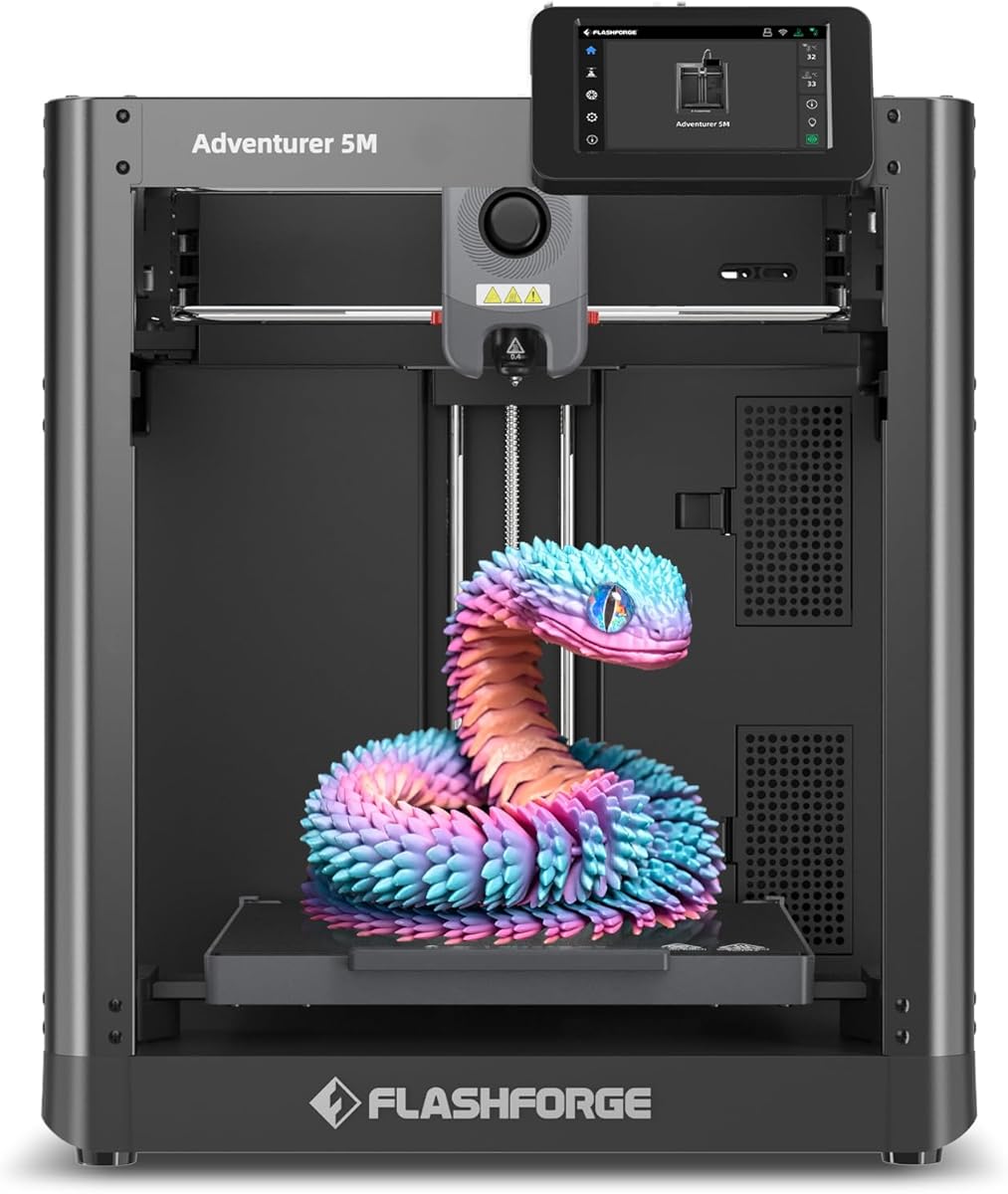
The FLASHFORGE Adventurer 5M offers impressive speed with its 600mm/s capability making it suitable for classrooms that need quick turnaround on projects. Its CoreXY all metal structure provides stability during high speed printing to maintain quality consistently.
We may earn a commission when you buy through this link, at no additional cost to you.
The detachable nozzle feature allows for quick swaps which is useful when teaching different materials or fixing clogs during busy lab sessions. The auto leveling system helps ensure consistent first layers reducing wasted material and time.
Despite the lower rating score it offers solid features for users who prioritize speed over advanced connectivity options. The high direct extruder temperature supports a wide range of common filaments used in education.
This model is a strong candidate for workshops where time is limited and quick prototyping is essential. The robust build quality suggests it can withstand the rigors of frequent classroom use over multiple years.
The 600mm/s travel speed allows students to complete models faster, freeing up time for design iterations and learning activities.
The all-metal CoreXY structure ensures the printer remains stable and precise even when running at maximum speeds for long periods.
We may earn a commission when you buy through this link, at no additional cost to you.
The Bambu Lab P1S is a reliable all-rounder that balances speed, safety, and material versatility. With an enclosed design it is safer for classrooms where airflow is limited or where students need protection from hot components.
We may earn a commission when you buy through this link, at no additional cost to you.
Its speed of 500mm/s and auto bed leveling make it easy to get high quality prints without constant monitoring. This is especially helpful for teachers who manage multiple printers or students working on independent projects.
The wide range of supported filaments allows for diverse educational projects from simple models to more complex engineering prototypes. The reliable performance means fewer interruptions during critical class time.
For schools seeking a robust printer that can handle a variety of materials and still be easy to manage, the P1S is a strong choice. It reduces the technical burden on educators while delivering professional results.
The fully enclosed body keeps hot surfaces and moving parts out of reach, making it safer for younger students to observe printing.
Support for multiple filament types means students can experiment with different materials to understand how properties affect print quality and durability.
We may earn a commission when you buy through this link, at no additional cost to you.
The FLASHFORGE AD5M delivers high performance with features like fully auto calibration and quick-swap nozzles that simplify the printing process for students. Its CoreXY all-metal structure ensures precise movement even at high speeds which is crucial for detailed models.
We may earn a commission when you buy through this link, at no additional cost to you.
The 1-click auto leveling system removes the guesswork from bed leveling making it easier for beginners to achieve good results on their first print. This helps maintain student confidence and enthusiasm for learning 3D design.
While the build area is somewhat limited the speed and precision make up for it in many educational scenarios. The ability to swap nozzles quickly allows teachers to adapt to different print requirements without significant downtime.
This model is well suited for classrooms where students need to see consistent results without complex setup steps. It encourages more printing attempts and learning opportunities which is vital for mastering design skills.
One-click auto leveling ensures every print starts correctly, reducing frustration and allowing students to focus on creativity and design.
The quick-swap nozzle design simplifies maintenance tasks, making it easier for students to learn basic machine care and troubleshooting.
We may earn a commission when you buy through this link, at no additional cost to you.
The Ugee Funbox is specifically designed for kids with a strong emphasis on safety and ease of use. Its UL GREENGUARD certification ensures low emissions which is critical for indoor use in schools and homes where air quality matters.
We may earn a commission when you buy through this link, at no additional cost to you.
With over 12000 pre-tested models and AI tools the Funbox offers endless creative possibilities. Kids can transform drawings or photos into 3D objects easily which makes learning design concepts intuitive and engaging.
The enclosed design with anti-pinch doors protects little fingers while the quiet operation prevents disruption in shared spaces. This attention to detail makes it a safe choice for environments with young students.
For parents and educators focused on safe and fun STEM activities the Funbox is an excellent option. It removes technical barriers and safety concerns so the focus remains entirely on creativity and learning.
The UL GREENGUARD certification and anti-pinch doors provide peace of mind that the printer is safe for children in classroom environments.
The vast model library and AI tools encourage independent exploration and creativity, allowing kids to design and build without needing constant help.
We may earn a commission when you buy through this link, at no additional cost to you.
This version of the Flashforge Adventurer 5M emphasizes speed and reliability with its 600mm/s capability and auto leveling features. The dual-sided PEI plate helps with model removal making it easier for students to handle prints after they are done.
We may earn a commission when you buy through this link, at no additional cost to you.
Vibration compensation technology ensures smooth surfaces even at high speeds which is important for professional looking results in class projects. The power loss recovery feature protects work from unexpected outages saving time and materials.
The open design is suitable for PLA and PETG which are the most common educational materials. It provides good ventilation but may not be ideal for materials that require enclosed environments for stability.
Educators looking for a printer that balances speed with ease of use will find this model practical. It minimizes maintenance and troubleshooting so teaching time remains focused on creative learning rather than technical issues.
Auto leveling ensures every print starts well, reducing wasted materials and keeping students focused on design rather than troubleshooting.
The 600mm/s speed allows quick completion of models, which helps keep students engaged and allows for more design iterations.
We may earn a commission when you buy through this link, at no additional cost to you.
The Snapmaker U1 offers advanced capabilities with its four independent toolheads and fast five-second tool change. This allows for true multi-color and multi-material prints without manual swapping which is powerful for teaching assembly and design.
We may earn a commission when you buy through this link, at no additional cost to you.
Its CoreXY motion system enables speeds up to 500mm/s while maintaining accuracy across a generous build volume. This means large or complex models can be printed efficiently which is great for university or high school labs.
The included software and model library make it easier to get started despite the advanced features. Students can focus on creativity and complex designs without worrying about filament changes or manual tooling.
For institutions that want to push the boundaries of what is possible with 3D printing the U1 is an excellent choice. It prepares students for professional workflows where speed and multi-material capabilities are increasingly valued.
The four toolheads allow complex parts with rigid and flexible materials, teaching students about design considerations and material properties.
The combination of high speed and a large build volume allows students to tackle ambitious projects that would take much longer on standard printers.
We may earn a commission when you buy through this link, at no additional cost to you.
The Bambu Lab A1 Mini Combo brings the speed and multi-color capabilities of the larger A1 in a more compact footprint. This makes it ideal for classrooms with limited space or for individual student workstations where space is at a premium.
We may earn a commission when you buy through this link, at no additional cost to you.
Its 10000mm/s2 acceleration ensures fast printing times even though the build volume is smaller. The included AMS lite allows students to experiment with multi-color designs which adds significant educational value and engagement.
The quiet operation and simple touchscreen interface make it a pleasant device to have in a classroom. Students can work independently without needing constant assistance which supports self-paced learning effectively.
For schools that want the benefits of a high-end printer in a smaller package the A1 Mini Combo is a smart choice. It offers advanced features that encourage exploration and creativity without taking up too much space.
The compact design allows multiple printers to fit in a standard classroom, enabling more students to work on projects simultaneously.
The included AMS lite provides an accessible way for students to learn about multi-color printing without needing expensive add-ons.
We may earn a commission when you buy through this link, at no additional cost to you.
Selecting the right printer involves balancing safety, speed, and educational value to meet the specific needs of your students and curriculum effectively.
When buying a 3D Printer for Educational Use, prioritize models with enclosed designs and filtration systems like HEPA or activated carbon. These features reduce exposure to fumes and particulates which is critical in classrooms where students spend many hours.
Safety features like anti-pinch doors and low emission certifications such as UL GREENGUARD ensure the environment remains healthy for everyone involved.
Educational printers should minimize technical hurdles such as manual bed leveling or complex calibration. Look for auto leveling systems and pre-assembled units so students can start printing within minutes of arrival.
Simplified workflows keep students focused on design and creativity rather than troubleshooting machine settings which can be frustrating for beginners.
Faster printers allow more iterations which helps students learn through trial and error. A build volume large enough for meaningful projects ensures the machine remains useful as skills improve over time.
Consider the class size and how many prints need to be produced to ensure the speed matches the demand of your curriculum schedule.
User-friendly software with model libraries and easy slicing tools is essential for education. WiFi control and remote monitoring allow teachers to track progress without being tethered to the printer.
Access to educational content and pre-made models reduces preparation time for instructors and helps students find inspiration quickly.
Support for common materials like PLA and PETG is standard, but advanced materials like TPU or ABS may be needed for engineering courses. Check the max nozzle temperature and enclosed design for material range.
A wider material range allows for more complex projects and prepares students for real-world design constraints they may face later.
Durable machines with easy maintenance access reduce downtime. Quick swap nozzles and reliable components ensure the printer can handle frequent use by many students without constant repairs.
Look for warranties and support that ensure long-term reliability so your investment remains useful for years to come.
While upfront cost matters consider filament usage and replacement part costs. Cheaper printers may use more material or require frequent upgrades which adds to the total cost over time.
Evaluate the value of included features like auto calibration to determine if a higher initial price saves money in the long run.
Some models offer built-in learning modules, guided projects, or AI design tools that integrate directly into lesson plans. These features can significantly enhance the educational value of the machine.
Prioritize printers that offer resources and software designed specifically for teaching rather than just raw hardware.
Begin by placing the printer on a stable surface away from high traffic areas to prevent accidental bumps. Ensure proper ventilation or use an enclosure to manage fumes effectively and keep the room air quality high.
Load filament correctly by following the on-screen instructions and run a test print to calibrate the first layer before starting student projects. Regularly check for debris and ensure the build plate remains clean for consistent adhesion.
Schedule routine maintenance like nozzle swaps and cleaning to prevent clogs and ensure smooth operation over time. Teach students basic troubleshooting to encourage independence and reduce the burden on educators during lessons.
The Ugee Funbox and Entina Tina2C are excellent choices because they feature enclosed designs and UL GREENGUARD certification which ensures low emissions. These models also include safety features like anti-pinch doors and cool-touch exteriors to protect younger students during operation.
The FLASHFORGE Adventurer 5M and Bambu Lab P2S Combo deliver the fastest printing speeds in the lineup with 600mm/s capabilities. This speed allows students to see results quickly and complete more iterations within a typical class period.
Yes, models like the Bambu Lab A1 and A1 Mini Combo support multi-color printing when equipped with the AMS lite system. This feature allows students to create complex and colorful designs without manual filament changes.
Most modern educational printers feature auto calibration and quick-swap nozzles to minimize daily maintenance. However, periodic cleaning of the build plate and occasional nozzle replacements are necessary to maintain print quality and prevent clogs.
Most models work with PLA and PETG which are safe and easy to use for beginners. Advanced models like the P2S Combo and Snapmaker U1 support engineering materials like ABS and ASA for more durable projects.
Yes, many of the models reviewed include WiFi connectivity and companion apps that allow for remote monitoring and control. This feature helps educators manage multiple devices from a single interface without physical presence.
Choosing the right 3D Printer for Educational Use depends on your specific needs ranging from safety features for younger students to speed and versatility for advanced programs. The models reviewed offer excellent options for every educational setting.
Prioritize safety, ease of use, and software support to ensure students spend time designing rather than troubleshooting. Investing in reliable hardware will pay dividends in long-term engagement and learning outcomes.
Prices and availability change frequently so check the latest details before purchasing. Verify that the model you select meets your current classroom constraints and educational goals for the best experience.