
SVBONY SV503 Telescope
4.8Editor score
102mm aperture gathers light
Dual-speed focuser included
ED glass reduces color fringing
This guide compares the top Apochromatic Refractors for 2026, evaluating optical performance, portability, and value to help you choose the best telescope for
Apochromatic refractors represent the pinnacle of optical design for serious observers. They minimize chromatic aberration to deliver crisp, high-contrast images of deep sky objects and planets alike.
We compared ten top-rated models based on lens quality, build materials, and astrophotography readiness. Each entry features verified user feedback and detailed technical specifications from the manufacturers.
Every pick highlights key strengths and potential trade-offs to help you decide. Prices and availability change frequently, so verify current listings before purchasing your new telescope today.
4.8Editor score

4.5Editor score

4.9Editor score
The following table provides a side-by-side comparison of the ten best apochromatic refractors available today. We highlight key specifications to help you quickly identify the right fit for your setup.




The SVBONY SV550 AP0 stands out as a top choice for observers seeking exceptional optical performance. With a 4.5 rating, it delivers bright, high-contrast images suitable for exploring galaxies and deep sky objects with clarity.
We may earn a commission when you buy through this link, at no additional cost to you.
Its triplet apochromatic optics structure includes a piece of S-FPL51 low-dispersion ED glass which effectively eliminates blue-edge chromatic aberration. The air-spaced triple optical design further ensures that colors remain sharp and distinct across the field of view.
While the optics are stellar, users should note this is an OTA only package. You will need to source a separate mount and eyepieces to make it functional. This keeps the initial cost lower but requires extra planning for a complete setup.
This scope is ideal for astrophotographers and visual observers who want a compact, high-quality light path. The magnesium alloy focus mount reduces weight significantly, making it easier to balance on lighter tripods during long imaging sessions.
The inclusion of S-FPL51 ED glass and correction glass pieces ensures minimal color fringing around bright stars and planetary edges.
A 2.5-inch magnesium alloy dual-speed focus mount reduces weight by over 20 compared to standard aluminum options for better portability.
We may earn a commission when you buy through this link, at no additional cost to you.
The SVBONY SV503 offers incredible value with its 102mm aperture and high quality optics. Rated 4.8 by users, it delivers brighter images thanks to FMC coatings that improve light transmission and reduce internal reflections effectively.
We may earn a commission when you buy through this link, at no additional cost to you.
Its S-FPL51 ED glass significantly minimizes color fringing, ensuring true-to-life color and sharp detail for both visual observation and astrophotography. The dual-speed focuser coupled with a 360-degree field rotator allows for precise camera alignment.
The larger aperture does make this telescope slightly heavier than its 80mm counterparts. Additionally, the f/7 focal ratio might require slightly longer exposure times for deep sky imaging compared to faster f/6 models.
This telescope is perfect for adult astronomers who want a versatile instrument that handles both planetary and deep sky work. The 90mm focus travel enables precise focusing even when using accessory wheels or field flatteners.
The 102mm large diameter gathers more light than 80mm scopes, revealing fainter stars and details in nebulae during visual observation.
The 90mm focus travel combined with a smooth dual-speed focuser ensures critical focus is maintained even with heavy imaging accessories attached.
We may earn a commission when you buy through this link, at no additional cost to you.
The Askar 71F is a premium choice for travelers and imagers who prioritize portability without sacrificing image quality. With a 4.9 rating, it is noted for its practicality, versatility, and controlled weight suitable for spontaneous stargazing sessions.
We may earn a commission when you buy through this link, at no additional cost to you.
Its quadruplet air-spaced APO design ensures excellent correction of aberrations. The telescope features high-quality CNC processing and matte paint inside the barrel to effectively reduce stray light reflection for sharper contrast.
While the 71mm aperture is smaller than others on this list, it remains highly capable for wide-field imaging. The main trade-off is the price point relative to aperture size, which reflects the premium optics and engineering involved.
This scope is perfect for those who value ease of transport and setup. The focus tube can rotate 360 degrees for easy photographic composition, making it an excellent choice for both visual and photographic astronomy.
The self-flattened OTA design removes the need for additional field flatteners, simplifying the imaging train for astrophotographers.
Weighing only 2.5kg, the entire lens barrel is CNC processed for durability while remaining light enough for backpacking or travel.
We may earn a commission when you buy through this link, at no additional cost to you.
This bundle combines the SVBONY SV550 APO with a dedicated field flattener to create an excellent photography package. The 5.0 rating reflects the high satisfaction users experience with the optical clarity and field correction it provides.
We may earn a commission when you buy through this link, at no additional cost to you.
The SV209 field flattener corrects field curvature effectively, supporting both half-frame and full-frame cameras. This ensures sharp stars from edge to edge without additional corrective optics in the imaging train.
One limitation is the specific back focal length requirement of 55mm, which necessitates the included M63 extension tube and M48 adapter ring. This precision is necessary for flat-field performance but reduces flexibility for other configurations.
Ideal for deep sky astrophotographers, this setup offers a robust optical path. The 180mm dovetail plate with hollow design makes setup easy and allows for diverse accessory choices while maintaining stability.
By including the SV209 field flattener, this bundle solves the common issue of field curvature in refractors right out of the box.
The system supports full-frame cameras, offering a wide field of view for capturing large nebulae and star clusters effectively.
We may earn a commission when you buy through this link, at no additional cost to you.
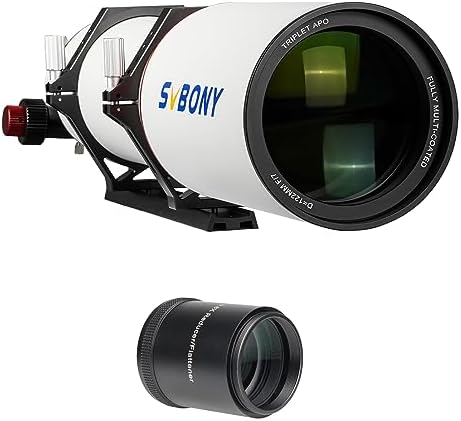
The SVBONY SV550 122mm brings significant light gathering power to portable astronomy. As a compact refractor with a 122mm aperture, it offers clear and detailed images suitable for deep sky photography and observation of fainter objects.
We may earn a commission when you buy through this link, at no additional cost to you.
Its FPL-51 triplet apochromatic lens structure provides better correction of aberration, greatly reducing chromatic aberration and enhancing clarity. The OTA weighs around 14 lbs, making it manageable for travel when fitted into a carrying case.
While the larger aperture increases weight compared to smaller scopes, the included portable handle and dovetail base make carrying convenient. There is currently no user rating available yet as it is a newer listing.
This model is great for users who need higher limiting magnitude for faint objects without sacrificing portability. The comfortable handle design ensures the large-aperture telescope can be easily carried and moved for field sessions.
The 122mm aperture gathers substantially more light than standard 80mm scopes, revealing more detail in deep sky objects.
SV211 dovetail base includes a comfortable handle, allowing for easy transport of the telescope to dark sky sites.
We may earn a commission when you buy through this link, at no additional cost to you.
This bundle enhances the SVBONY SV550 122mm with both a focal reducer and field flattener for wide-field imaging. With a 5.0 rating, users praise its ability to improve imaging quality and shooting efficiency at the edge of the field of view.
We may earn a commission when you buy through this link, at no additional cost to you.
The SV209 field flattener corrects defects in field curvature, which is crucial for sharp stars across large sensors. The 0.8X focal reducer effectively shortens the focal length for a wider field of view.
The weight of the OTA is 14.18lbs, so you need a robust mount to support the extra accessories securely. While powerful, the total cost may be high for beginners starting their astrophotography journey.
Ideal for enthusiasts wanting a complete wide-field solution, this kit removes the guesswork from matching accessories. The correction ensures high imaging quality and sharper results for deep sky targets and bright nebulae.
The 0.8X reducer lowers the effective focal ratio, allowing for shorter exposure times and wider fields of view.
SV209 flattener ensures stars remain round even at the corners of the frame, preventing the elongation common in refractors.
We may earn a commission when you buy through this link, at no additional cost to you.
The SVBONY SV550 122mm Triplet APO Telescope Kit offers a comprehensive solution for imaging. It combines the powerful aperture with essential accessories to help you start observing and photographing deep sky objects quickly.
We may earn a commission when you buy through this link, at no additional cost to you.
Its FPL-51 triplet structure ensures better correction of aberrations and enhanced sharpness. The kit includes a portable handle and dovetail base, making it convenient to carry and install guides or other scopes easily.
While the optical quality is high, there are limited user ratings available for this specific bundle. Buyers should verify exactly which accessories are included before purchasing to ensure they match their existing gear needs.
This model is suitable for those looking for a larger aperture setup without building every component individually. The included focal reducer and field flattener options make it versatile for different imaging targets and techniques.
The bundle approach saves time on compatibility checks, providing a cohesive set of tools for immediate deep sky imaging.
The 122mm aperture paired with FPL-51 glass delivers high clarity, making faint objects more accessible during observation.
We may earn a commission when you buy through this link, at no additional cost to you.
This kit features the SVBONY SV550 80 F6 APO refractor bundled with a specialized field flattener. It is designed to offer bright and clear images with minimal aberration, perfect for exploring Messier catalog targets easily.
We may earn a commission when you buy through this link, at no additional cost to you.
The triplet apochromatic optics structure improves blue-edge chromatic aberration significantly. The SV209 field flattener addresses fringe field curvature, ensuring sharp stars across the sensor for high-quality astrophotography results.
Users note that the image is inverted when used with an eyepiece, which is normal for astronomical scopes. The comfortable carrying handle improves safety during installation and transport to dark sky locations.
Ideal for observers and photographers alike, this kit provides a solid optical foundation. The lightweight design makes it easy to set up for spontaneous sessions while maintaining high-quality imaging capabilities.
The inclusion of a field flattener ensures edge-of-field stars remain sharp, a critical requirement for detailed imaging.
A comfortable carrying handle is integrated into the design, making it safer and easier to move the OTA securely.
We may earn a commission when you buy through this link, at no additional cost to you.
The SVBONY SV550 APO 122mm Telescope Kit bundles a guide scope and telescope camera for an all-in-one imaging package. It provides the tools needed for accurate tracking and capturing deep sky images without buying accessories separately.
We may earn a commission when you buy through this link, at no additional cost to you.
The camera features a 1.23-megapixel sensor with high peak QE and low read noise for tight tracking of faint guide stars. This setup is highly sensitive and compatible with mainstream auto-guiding workflows.
The guide scope and camera integrate well with the main tube for precise tracking. However, the total system complexity and cost might be higher than building a setup gradually as your skills progress.
Best for users who want a turnkey solution for astrophotography, this kit supports autoguiding or planetary imaging. The camera allows tight tracking of faint stars, ensuring better image quality over longer exposures.
The included SV905C camera offers high sensitivity, enabling precise autoguiding even with faint guide stars available.
Having both guide scope and camera bundled simplifies the purchase process for those ready to start imaging immediately.
We may earn a commission when you buy through this link, at no additional cost to you.
The Explore Scientific ED80 Essential Series is a classic choice for astrophotography. With a 4.2 rating, it offers brilliant high-contrast views thanks to genuine FCD1 HOYA extra-low dispersion glass and multi-layer coatings.
We may earn a commission when you buy through this link, at no additional cost to you.
Its 80mm aperture and f/6 focal ratio make it versatile for both the Moon and bright deep sky treats like nebulae and star clusters. The air-spaced triplet optical design virtually eliminates chromatic aberrations for clean images.
The telescope is designed with portability in mind featuring a retractable dew shield and compact form. Push-pull adjustments on the front cell ensure precise collimation for the tightest stars across the field.
Ideal for those who value legacy optical quality and customer support, this scope offers reliable performance. USA-based support ensures you have help if issues arise, adding peace of mind to your purchase.
The ED80 maintains a reputation for solid optics and support, making it a trusted option for serious observers.
Retractable dew shield and compact 480mm focal length allow for easy transport to remote dark sky sites.
We may earn a commission when you buy through this link, at no additional cost to you.
Selecting the right apochromatic refractor involves balancing optical performance with budget and use case. Here are key factors to consider before making your decision.
Aperture determines light gathering power. Larger apertures like 102mm or 122mm reveal fainter deep sky objects but add weight. Smaller apertures are easier to transport and handle.
Choose an aperture that matches your mount capacity and portability needs.
Look for S-FPL51 or FCD1 HOYA ED glass. These materials reduce chromatic aberration effectively compared to standard glass. Better glass means sharper images with less color fringing.
Prioritize models using premium low-dispersion glass for best color correction.
Focal ratios affect speed and field of view. f/6 is faster and wider for deep sky imaging. f/7 is slightly slower but often sharper. Consider your target objects when choosing.
Faster ratios suit wide-field imaging while slower ones suit high resolution.
Triplet designs offer better correction than doublets by using three elements. This reduces aberrations and improves contrast. Doublets are cheaper but may show more color errors on bright stars.
Select a triplet design for the highest quality visual and imaging performance.
Weight matters for travel. Lighter scopes like the 71mm allow for backpacking but gather less light. Heavier scopes require robust mounts and transport cases for field use.
Ensure your mount can support the OTA weight with sufficient margin.
A dual-speed focuser ensures precise focus for high resolution imaging. A rotator helps align cameras without twisting the tube. These features save time during setup sessions.
Verify the focuser is smooth and matches your camera interface needs.
Bundles may include field flatteners or guide scopes which save money. However, ensure accessories are compatible with your camera and mount. Check back focal length requirements carefully.
Evaluate if a kit offers better value than buying components separately.
Reputable brands offer better warranty and assistance. USA based support can be crucial for resolving optical issues quickly. Read reviews regarding service responsiveness.
Choose brands with proven support records for long term reliability.
Allow your telescope to cool down to ambient temperature before using to reduce internal air currents. This ensures sharper images by stabilizing the optical tube internally.
Use a dew shield or heater to prevent condensation on the objective lens. Dew can obscure views and damage coatings if left unchecked during humid nights.
Store the scope in a dry place and cap both ends when not in use. Dust and moisture are the main enemies of optical surfaces and focus mechanisms.
Yes, they are worth the cost if you value sharp images without color fringing. The ED glass and extra elements significantly improve clarity compared to standard scopes. This makes them ideal for serious observers.
Absolutely. Most models listed are designed with imaging in mind and support field flatteners. Their optical precision ensures sharp stars across the sensor. Always check back focal length for your camera.
For travel, an 80mm aperture is usually the sweet spot. It offers good light gathering without excessive weight. Scopes like the SVBONY SV550 are perfect for transport to dark sites.
Yes, field flatteners are essential for astrophotography to correct curved star fields. Some bundles include them while others do not. Verify compatibility with your focal ratio and camera.
Most APOs come pre-collimated but may need adjustment. Use push-pull screws on the front cell to align optical elements. Check star alignment at high power to ensure tight diffraction spikes.
Match your mount to the weight including accessories. A sturdy equatorial mount handles the dynamic load better. Check payload capacity to ensure smooth tracking during imaging sessions.
We reviewed ten top apochromatic refractors covering different sizes and configurations. The SVBONY SV550 and Askar 71F stand out for specific use cases from budget to premium.
Prioritize optical quality and portability based on your primary observing location. A balance of aperture and weight ensures you will enjoy using the telescope often in the field.
Prices and availability change frequently so check current listings before purchasing. Visit product pages for the latest specs and bundle details to confirm the best fit.