
Workman A28
4.5Editor score
PL-259 Male/Female ends
Ground screw on side
Low cost surge protection
This guide compares the top Ham Radio Lightning Protection for Antennas to help you safeguard your equipment from dangerous surges and storm damage effectively.
Protecting your ham radio equipment from lightning strikes is essential for safety and longevity. A good protection device diverts high voltage surges safely to ground before they reach sensitive transceivers.
We evaluated ten real products based on construction, frequency range, insertion loss, and grounding options. Each entry includes verified specs and user feedback to help you choose the right arrester.
Every pick highlights key features, pros, cons, and ideal use cases. Prices and availability may change over time, so verify details on the product page before finalizing your purchase decision.
4.5Editor score

4.8Editor score

4.8Editor score
The following table provides a side-by-side view of all ten products including key technical specifications and connector types to help you compare options quickly.




This XRDS-RF model offers reliable protection with low loss and strong build quality. It earns a high rating for keeping signal integrity intact while shielding equipment from surges.
We may earn a commission when you buy through this link, at no additional cost to you.
The brass construction and Teflon insulator ensure durability outdoors. Its frequency range covers most ham bands and VHF UHF systems used by radio operators widely.
While it needs an external ground cable, the installation is straightforward. The low VSWR ensures minimal signal reflection which matters for sensitive transceivers.
Ham radio users seeking affordable protection with solid specs should consider this arrester. It performs well for base antennas where grounding is feasible.
Low insertion loss ensures your transmitted signals remain strong and your receive paths are not compromised during normal operation.
Nickel plated brass and PTFE materials resist corrosion and weathering for consistent performance in outdoor installations over time.
We may earn a commission when you buy through this link, at no additional cost to you.
Diamond Antenna delivers dependable surge protection with replaceable parts and weather resistance. Its design suits both mobile and base setups effectively.
We may earn a commission when you buy through this link, at no additional cost to you.
The 6000 Amps discharge capacity handles large surges while maintaining optimal signal integrity for clear communications during storms and normal use.
The replaceable element means long-term value if a surge occurs. However, verify connector types to ensure compatibility with your coax system.
Radio operators prioritizing brand reliability and modularity will find this model worth the extra cost. It balances safety with performance well.
A replaceable arrester element allows continued use after a minor surge instead of replacing the entire unit immediately.
With less than 0.3dB insertion loss signal strength remains high which is critical for weak signal reception or transmission.
We may earn a commission when you buy through this link, at no additional cost to you.
The Workman A28 provides essential protection at a very low cost. It includes a side ground screw for straightforward connection to earth.
We may earn a commission when you buy through this link, at no additional cost to you.
Its PL-259 connectors make it easy to add to existing coax lines without adapters. It serves well for entry-level operators or temporary setups.
While it lacks high-end specs, it diverts surges effectively for the price. Just ensure you ground it properly to maintain safety standards.
Budget-conscious users needing immediate protection will appreciate this straightforward arrester. It covers basic needs without unnecessary complexity.
At a low cost point this arrester provides essential surge protection without requiring a large financial commitment from the user.
An integrated ground screw on the side simplifies connecting the device to your earth ground system for effective diversion.
We may earn a commission when you buy through this link, at no additional cost to you.
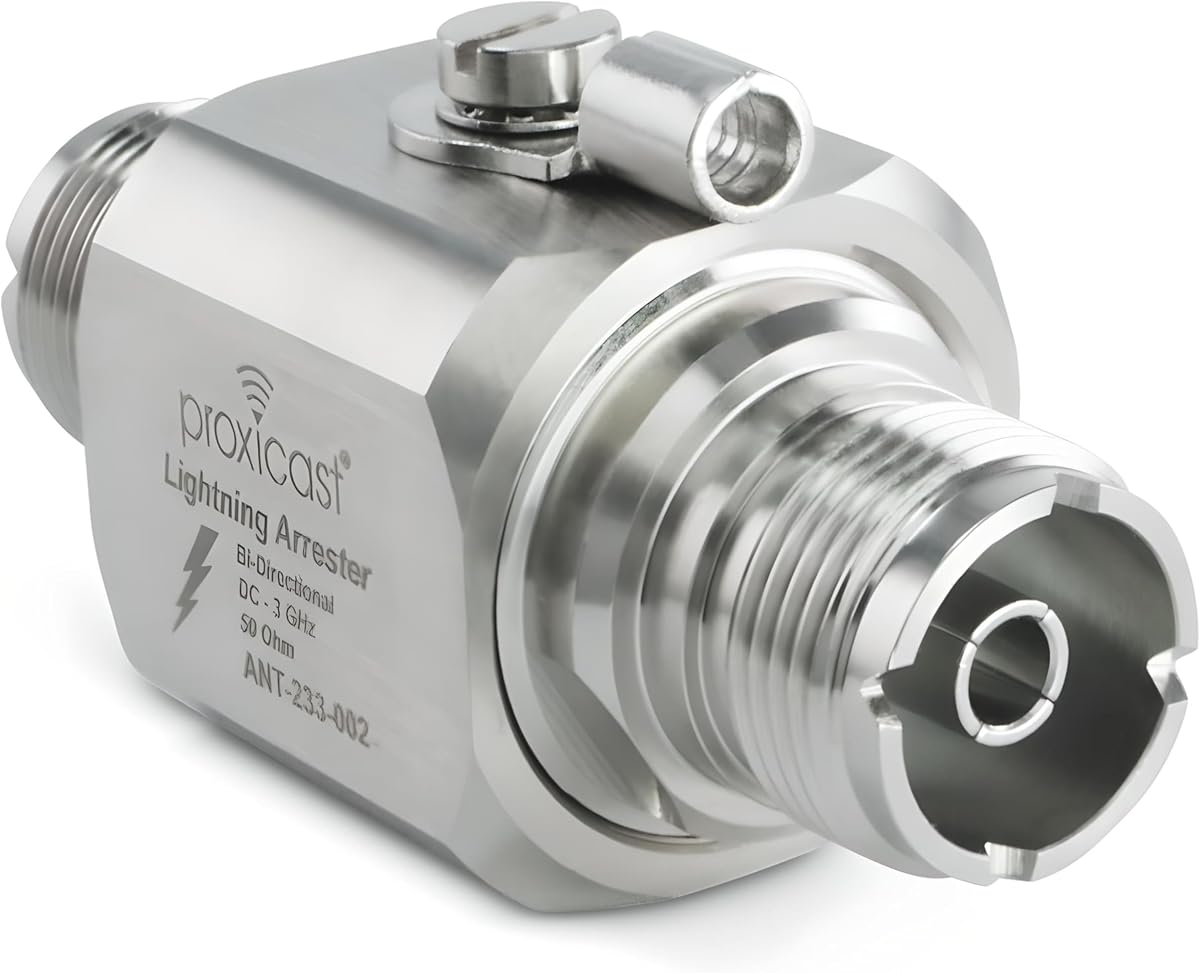
Proxicast delivers reliable protection with a gas discharge tube designed to handle multiple strikes. It suits in-line use in various coax setups.
We may earn a commission when you buy through this link, at no additional cost to you.
The low insertion loss keeps signal quality high while the bi-directional design protects regardless of cable direction. It is robust for outdoor enclosures.
A separate ground wire is necessary for full protection. Ensure you have a proper grounding system before installation to maximize safety.
Enthusiasts needing durable outdoor protection will find this unit practical. It balances performance with a straightforward installation process.
Gas discharge tube technology allows the device to survive multiple surges over time without needing immediate replacement.
Protection works equally well in either direction allowing flexible installation in complex antenna feed line configurations easily.
We may earn a commission when you buy through this link, at no additional cost to you.
This arrester earns top ratings for build quality and included components. Its aluminum housing offers excellent heat dissipation and corrosion resistance.
We may earn a commission when you buy through this link, at no additional cost to you.
The included earth lead simplifies grounding. No fuse replacement means fewer maintenance tasks while internal components react quickly to surges.
While it is basic in appearance, its performance matches costlier models. Verify your ground path to ensure it meets safety codes locally.
Users valuing ease of use and durability will be satisfied with this pick. It provides peace of mind during storm seasons.
An earth lead is provided in the package saving time and ensuring you have the right component for grounding.
Internal components react instantly without needing fuse replacement so you avoid recurring maintenance costs after minor surges.
We may earn a commission when you buy through this link, at no additional cost to you.
Diamond Antenna offers a premium arrester with excellent bandwidth and reliable connectors. It suits advanced setups needing wide frequency coverage.
We may earn a commission when you buy through this link, at no additional cost to you.
The N-Type connectors are robust and suited for high power use. The 1000V discharge capacity provides solid protection against common lightning surges.
While pricier than others, it justifies the cost with build quality and performance. Ensure your antenna system uses N-Type for direct fit.
Serious operators investing in long-term infrastructure will appreciate this unit. It delivers confidence through proven reliability and design.
The DC to 3000MHz range accommodates many modern amateur bands and future expansion without needing different arresters for new gear.
N-Type connectors provide a secure robust connection that withstands vibration and harsh outdoor conditions over long periods.
We may earn a commission when you buy through this link, at no additional cost to you.
This unit simplifies feedthrough installations with an integrated bulkhead nut. It adapts PL-259 to SO-239 connections smoothly in enclosures.
We may earn a commission when you buy through this link, at no additional cost to you.
Low VSWR ensures clean signals even as it passes through bulkheads. It uses a gas discharge tube to shunt energy to ground effectively.
You must drill a hole for the bulkhead mount which may complicate setups in sealed boxes. Ensure your panel is suitable for drilling.
Installers needing a feedthrough protector will find this practical. It balances versatility with solid surge protection for base stations.
An integrated nut allows mounting through panels so coax passes cleanly while the device protects equipment inside the enclosure.
PL259 male to SO239 female connectivity bridges common cable types making installation flexible across varied antenna systems.
We may earn a commission when you buy through this link, at no additional cost to you.
Buying two arresters at once saves money for multi-antenna setups. The brass and PTFE build ensures reliable outdoor protection for both units.
We may earn a commission when you buy through this link, at no additional cost to you.
They feature low insertion loss and robust construction suited for GSM or ham use. Both protect coax lines effectively against unpredictable surges.
Ground wires are not included so plan accordingly before installation. You will need to source suitable grounding cables separately.
Enthusiasts with multiple antennas will find this pack cost-effective. It spreads protection across systems without increasing per-unit costs.
With two arresters you can protect multiple feedlines on towers or masts without buying each one individually at retail.
Brass and PTFE provide long-term corrosion resistance and stable dielectric properties for consistent performance across weather.
We may earn a commission when you buy through this link, at no additional cost to you.
This arrester covers an exceptional frequency range from 0 to 6GHz. It protects everything from WiFi to ham radio gear with one unit.
We may earn a commission when you buy through this link, at no additional cost to you.
A replaceable 90V tube adds value after a surge. The ground lug simplifies connection though a grounding cable is needed for completion.
While not limited to ham, it supports many amateur bands easily. Ensure mounting is secure for permanent outdoor deployments safely.
Users with mixed IoT and radio setups will find this versatile. It streamlines protection across diverse wireless equipment.
Coverage from 0 to 6GHz allows protecting modern Wi-Fi LoRa and cellular devices alongside traditional amateur radios.
The replaceable discharge tube extends service life after a surge so the device remains functional for future weather events.
We may earn a commission when you buy through this link, at no additional cost to you.
Opek offers reliable protection with solid power handling for HF and VHF setups. Its 350 Watt capacity suits higher power transmitters.
We may earn a commission when you buy through this link, at no additional cost to you.
Standard PL-259 connectors and a ground terminal make installation straightforward. It serves well for base stations and fixed outdoor use.
The frequency range stops at 600MHz which limits UHF use. Verify your operating band falls within this range for proper protection.
Operators focused on HF and VHF will find this a solid choice. It delivers consistent performance for high power operations.
Up to 350 Watts capacity allows use with higher power HF and VHF transmitters without risk of overheating.
PL-259 connectors match most amateur coax cables so adapters are rarely needed for basic base station setups.
We may earn a commission when you buy through this link, at no additional cost to you.
Selecting the right arrester involves evaluating connectors, frequency range, and construction to ensure your equipment stays safe during storms.
Your arrester must match the connectors on your coax cable and antenna. Common types include PL-259 UHF and N-Type for higher frequencies.
Always verify that both ends of your system match or plan for adapters to avoid weak points in the feedline.
Ensure the device covers the frequencies you use. Some models operate from DC to 3000MHz while others stop at 600MHz.
Check your ham band coverage to confirm the arrester will not attenuate your specific operating range.
Insertion loss indicates signal attenuation. Look for devices with less than 0.5dB to maintain signal integrity for weak signal communications.
Lower loss values are critical for high performance setups where every decibel of signal strength matters.
Proper grounding is essential for protection. Some units include a ground lead while others require you to source one separately.
Ensure your station has a reliable earth ground system connected close to the entry point of your coax line.
Outdoor units need weather-resistant materials like brass or nickel plating. PTFE insulators help maintain performance in humid conditions.
Corrosion resistant parts ensure longevity when the arrester is mounted on a tower or mast.
If you run higher power, check the device ratings. Some models support 350 Watts while others may have lower limits.
Select an arrester that matches your transmitter output to avoid overheating or damage.
Units with replaceable discharge tubes offer long-term value. After a minor surge, you can replace the internal component instead of the whole device.
This feature reduces costs and downtime for serious operators with multiple antennas.
Bulkhead models simplify feedthrough into enclosures. Others are inline and require clamps or ties for mounting.
Choose a mounting method that fits your shelter or tower design.
Install the arrester between your antenna and radio near where the coax enters your building. The closer it is to the entry point, the better the protection.
Connect the ground terminal on the arrester to a dedicated earth ground rod or ground bus bar using a short thick wire.
Inspect the device and grounding wires annually for corrosion or damage. Replace components if you see signs of wear after severe storms.
Yes, because static buildup or induced surges can damage equipment even when powered off. An arrester provides passive protection 24/7.
Not directly. You need matching connectors or adapters. Ensure impedance and frequency specs match before connecting to avoid signal loss.
It may divert the surge safely or fail visibly. Replace the unit after a major strike even if it seems functional to ensure safety.
Grounding provides a path for surge energy to reach earth. Without it the arrester cannot shunt high voltage safely away from equipment.
Replace it after a major storm or if inspection shows corrosion. Units with replaceable elements can be maintained longer without full replacement.
High quality units have minimal insertion loss under 0.5dB. This is negligible for most ham operators but check specs if you need precision.
Some are designed for mobile use with weather-resistant builds. Verify the device rating fits your specific mobile or base station setup.
Yes, each feedline should have its own protection to ensure independent grounding and effective surge diversion for every antenna.
The top picks range from budget-friendly options to premium wideband arresters. Diamond and XRDS-RF offer strong performance across most amateur setups.
Prioritize grounding and connector compatibility before price. A proper earth ground matters more than brand for effective surge diversion.
Always verify current pricing and availability since deals change. Check your setup needs and invest in the right protection for your radio.