
SOLPERK 20W Kit
4.5Editor score
Includes charge controller
Adjustable mounting bracket
Waterproof and durable
This comprehensive guide compares the top ten marine solar panels for 2026, evaluating efficiency, durability, and value for boat owners seeking reliable
Marine solar panels are essential for boaters who want reliable power without relying on generators or shore connections. Choosing the right panel depends on your vessel size, energy needs, and budget constraints.
We compared ten top-rated models based on efficiency, build quality, and customer feedback. Our analysis covers rigid, flexible, and kits to help you find the perfect fit for your boat.
Each pick highlights key features and real-world performance. Prices change often, so verify current listings before purchasing to ensure you get the best value for your investment today.
4.5Editor score

4.8Editor score
4.6Editor score
The following table provides a side-by-side comparison of all ten marine solar panel options. Review the specifications to find the ideal solution for your specific boating needs and energy requirements.


The Callsun 200W N-Type panel earns our Editor's Choice for its exceptional 25.6% efficiency and bifacial design that harvests light from both sides. It delivers robust power for larger marine setups.
We may earn a commission when you buy through this link, at no additional cost to you.
Its N-Type monocrystalline cells with 16BB busbars minimize microcrack risks and hot spots. The twin parallel module design ensures one half keeps working even if the other is shaded by rigging.
While it needs unobstructed mounting to maximize rear-side gain, the performance gain is significant. The low temperature coefficient also means better output during hot summer afternoons on the water.
Boaters with enough deck space looking for top-tier efficiency should choose this model. It stands out as the most advanced and reliable option for serious off-grid marine power needs.
This panel captures direct sunlight on the front and reflected light off the deck on the back, increasing total energy harvest significantly.
Independent dual modules allow power generation to continue even when parts of the panel are blocked by masts or sails.
We may earn a commission when you buy through this link, at no additional cost to you.
The SOLPERK 20W kit is the top budget pick for small boats or battery maintenance. It includes the panel, controller, and mounting bracket to get you started quickly.
We may earn a commission when you buy through this link, at no additional cost to you.
Its monocrystalline cells offer solid efficiency for the price, and the smart controller protects your battery from overcharging. The adjustable bracket helps aim for the sun easily.
While 20W won't run high-load appliances, it is perfect for keeping batteries topped off. It is ideal for weekend boats that need a simple, reliable charging solution.
If you want an entry-level system without extra parts, this kit is the smart choice. It provides all the essentials to maintain your marine battery health affordably.
You get the panel, controller, bracket, and cables in one box, removing guesswork for first-time solar buyers.
The included bracket lets you angle the panel toward the sun, optimizing intake even on small decks.
We may earn a commission when you buy through this link, at no additional cost to you.
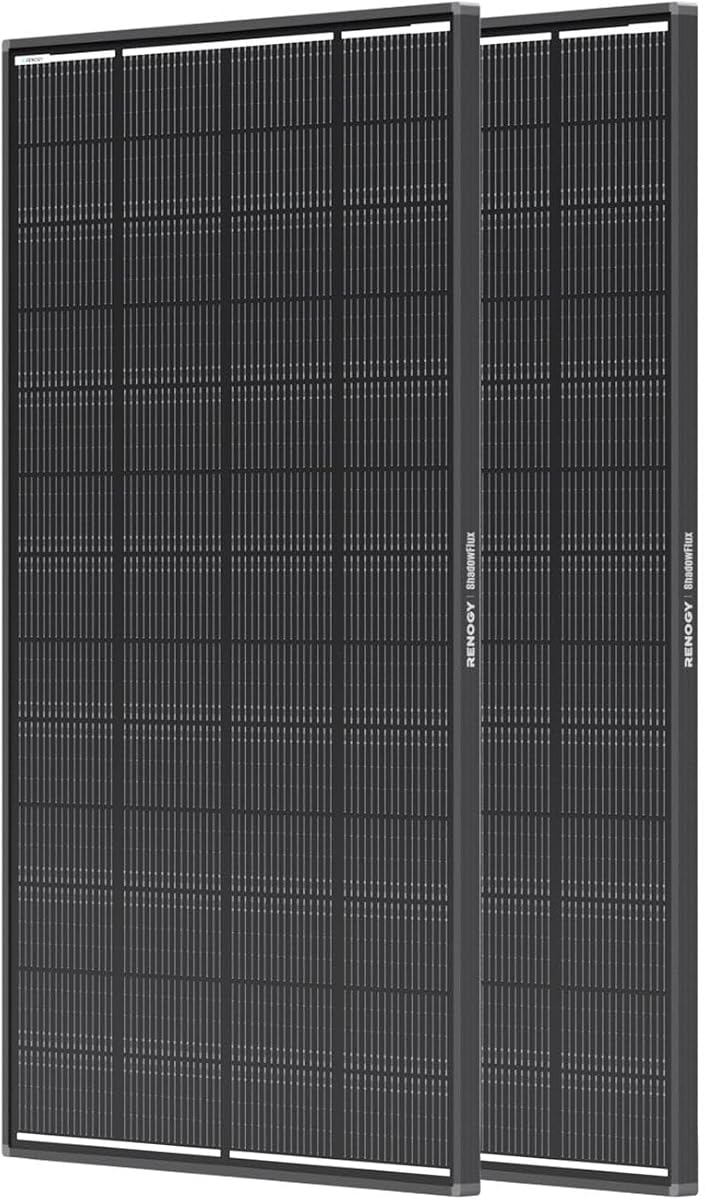
This 400W ShadowFlux panel is a premium choice for large vessels needing serious power. It uses N-Type cells to deliver 25% efficiency in a compact layout.
We may earn a commission when you buy through this link, at no additional cost to you.
The ShadowFlux anti-shading tech protects against power loss when rigging or sails block sunlight. It is built to withstand heavy snow and wind loads with IP67 protection.
The main trade-off is the physical space required, but the power density is excellent. It is perfect for liveaboards or boats with significant power budgets.
Invest in this model if you need reliable, high-capacity power and have the deck area to support it. It delivers top-tier performance and durability for demanding marine use.
Advanced cell interconnect technology ensures shading on one part doesn't kill output from the entire panel.
N-Type cells degrade slower and perform better in heat than older technologies, ensuring long-term value.
We may earn a commission when you buy through this link, at no additional cost to you.
SUNER POWER brings high-end MPPT tech to a 20W trickle charger. It tracks the maximum power point with 99% efficiency for optimized charging.
We may earn a commission when you buy through this link, at no additional cost to you.
Visual indicators let you see charge status clearly. The three modes support AGM, Lithium, and standard lead-acid batteries, making it versatile for modern boat electronics.
The suction cup mount is convenient for temporary placement, but less permanent than drilled options. It is best for small boats or auxiliary charging.
Choose this if you want advanced charging logic in a small package. It ensures your batteries stay healthy with minimal effort on sunny days.
Unlike basic PWM controllers, MPPT adjusts voltage to extract every watt available from the panel.
Supports Lithium and AGM modes, ensuring safe charging for modern battery types.
We may earn a commission when you buy through this link, at no additional cost to you.
Renogy's 100W N-Type panel balances power and value well. Its 25% efficiency and low temperature coefficient ensure steady performance in varied climates.
We may earn a commission when you buy through this link, at no additional cost to you.
The low temperature coefficient means it maintains output even in heat. It comes with a 25-year performance warranty, showing strong confidence in longevity.
While rigid, it is standard for boat decks. It is a great upgrade for small boats needing more than trickle power without a huge investment.
For reliable mid-sized power, this model is a safe bet. It offers excellent efficiency and a track record of durability in harsh marine environments.
Low heat loss means more usable energy in summer, unlike older panels that lose efficiency in heat.
Grade A+ cells ensure consistent high performance and lower degradation over the lifespan.
We may earn a commission when you buy through this link, at no additional cost to you.
This 200W ShadowFlux panel brings Renogy's anti-shading tech to a mid-sized option. It reduces hot spots and power loss when masts or rigging cast shadows.
We may earn a commission when you buy through this link, at no additional cost to you.
Its compact size helps on crowded decks. N-Type cells ensure efficient power generation even on cloudy days, delivering 25% cell efficiency.
While the price is higher than older tech, the reliability is worth it. It is a smart upgrade for boats that can't avoid shade issues.
If space and shading are concerns, this model is a great choice. It combines high efficiency with practical design for real-world marine conditions.
Reduces energy drops when parts of the panel are covered, ensuring consistent power generation.
Delivers high wattage in a smaller footprint, ideal for boats with limited roof space.
We may earn a commission when you buy through this link, at no additional cost to you.
This flexible 200W panel is the top choice for curved decks or fiberglass surfaces. It bends up to 240 degrees and weighs half as much as rigid panels.
We may earn a commission when you buy through this link, at no additional cost to you.
PERC half-cut cells provide good efficiency, and the frameless design reduces wind resistance. It is perfect for sailboats or curved cabins.
While flexible panels degrade faster than rigid ones, this model is robust. It simplifies installation where drilling is impossible or aesthetically undesirable.
Choose this for curved or uneven surfaces. It offers a seamless look and easy install without compromising power output for most boats.
Bends to match curved decks or rails, allowing installation where rigid panels simply will not fit.
Lighter weight reduces stress on the structure, while the all-black look blends in cleanly.
We may earn a commission when you buy through this link, at no additional cost to you.
The 120W ShadowFlux offers a compact alternative with anti-shading benefits. It is 10% smaller than standard panels, fitting tighter spaces easily.
We may earn a commission when you buy through this link, at no additional cost to you.
N-Type cells ensure high efficiency and longevity. The compact size makes it ideal for boats where space is a limiting factor.
While not as powerful as 200W options, it strikes a great balance. It provides solid power without cluttering your deck.
Opt for this if you need reliable power in tight spaces. It delivers strong performance in a sleek, space-saving design.
Compact dimensions let you fit more panels or use tricky spots on your boat.
N-Type cells ensure consistent 25% efficiency and long-term power output.
We may earn a commission when you buy through this link, at no additional cost to you.
SUNER POWER brings MPPT efficiency to 50W. It is perfect for moderate charging needs, bridging the gap between trickle and full systems.
We may earn a commission when you buy through this link, at no additional cost to you.
Visual indicators show charge progress, and the waterproof design suits marine use. The MPPT controller ensures you get every watt possible.
While 50W isn't a full system, it helps support small loads like lights or pumps. It is a smart add-on for maintaining battery health.
Choose this for supplemental power. It offers advanced technology in a compact, affordable package.
Advanced controller extracts maximum power from the panel, improving charge speed significantly.
LED indicators let you verify charging status without needing extra meters.
We may earn a commission when you buy through this link, at no additional cost to you.
The POWOXI 7.5W is the smallest option, designed for maintaining batteries when parked. It plugs directly into cigarette outlets for effortless charging.
We may earn a commission when you buy through this link, at no additional cost to you.
Its LED indicator confirms sunlight and charging status. While small, it prevents dead batteries during storage without complex setups.
It is not for running devices, just maintenance. It is ideal for boats in storage or for small auxiliary batteries.
Choose this for storage charging. It is the simplest way to prevent drain without wires or controllers.
No wiring needed. Just plug into the lighter socket to maintain the battery easily.
Tiny size lets you store it inside the boat when not in use.
We may earn a commission when you buy through this link, at no additional cost to you.
Selecting the right panel requires understanding your energy needs, available space, and budget. Below are the key factors to consider for a successful marine solar setup.
Determine your daily power needs in amp-hours. For small boats maintaining batteries, 20W to 100W may suffice. Larger vessels with fridges or lights should consider 200W or more.
Choose wattage that covers at least 80% of your daily consumption to ensure reliable independence.
Higher efficiency panels produce more power in less space. Modern N-Type panels often reach 25% efficiency compared to 15% for older models.
Prioritize high-efficiency models if deck space is limited.
Rigid panels are cheaper and last longer but need flat surfaces. Flexible panels conform to curved decks but degrade faster and cost more.
Select rigid for flat surfaces and flexible for curved hulls or biminis.
Marine environments often have shade from masts. Look for panels with bypass diodes or anti-shading tech to maintain power when partially covered.
Anti-shading tech ensures consistent output despite obstacles.
Saltwater and UV exposure are harsh. Choose panels with corrosion-resistant frames, IP65 rated junction boxes, and UV-stable laminates.
IP67 rated panels ensure long-term reliability in marine conditions.
Always use a charge controller. MPPT controllers extract up to 30% more power than PWM models for larger systems.
Use MPPT for panels over 100W and PWM for smaller 20W setups.
Verify mounting options. Some panels include pre-drilled holes, while others need brackets. Marine environments need stainless steel or aluminum mounts.
Use stainless steel hardware to prevent rust and ensure secure mounting.
Look for warranties of 10 years or more. Reputable brands offer coverage against defects and performance degradation over time.
Ensure the manufacturer has a solid reputation for customer support.
Position your panels where they receive maximum sunlight throughout the day. Aim them at the sun's path, avoiding shade from rigging or sails.
Clean your panels regularly with fresh water and a soft cloth to remove salt and debris. Avoid abrasive materials that scratch the surface and reduce efficiency.
Inspect wiring and connections for corrosion. Use marine-grade connectors and cover unused ports. Ensure your charge controller and batteries stay dry and secure.
Flexible panels are better for curved surfaces like boat cabins but cost more and last less. Rigid panels offer higher efficiency and durability for flat decks. Choose based on your mounting surface and needs.
Small boats maintaining batteries need 20W to 50W. Liveaboards or vessels running appliances need 200W or more. Calculate your daily amp-hour usage to determine exact size requirements.
Yes, always use a charge controller to prevent battery overcharging. MPPT controllers are best for efficiency, especially with higher wattage panels. PWM is acceptable for small trickle chargers.
Most panels are water-resistant, but saltwater corrosion is a risk. Choose panels with corrosion-resistant frames and IP67 rated junction boxes. Rinse regularly with fresh water to minimize salt buildup.
Quality panels last 20 to 25 years. Rigid panels typically outlast flexible ones. Proper installation and regular cleaning extend lifespan significantly.
Yes, connecting panels in parallel increases current while keeping voltage stable. Use a combiner box and proper wiring to manage the output safely for your battery bank.
Yes, but output drops to 10% to 20% of peak power. Bifacial and N-Type panels perform better in low-light conditions. Design systems to handle variable weather patterns.
We hope this guide helped you find the perfect solar solution for your boat. The Callsun 200W N-Type panel is our top pick for efficiency, while the SOLPERK kit offers the best value for small setups.
Prioritize efficiency and durability to ensure reliable power on the water. Match the wattage and panel type to your vessel's space and power needs.
Remember to check current prices and warranty terms before buying. Investing in quality solar today ensures energy freedom and savings on the water tomorrow.